
One piece of practice management advice has achieved something close to consensus: financial advisers who centre client goals in their practice tend to produce better outcomes than those who do not. The guidance on this is fairly consistent and, for the most part, correct. Which may be precisely why the assumption running through it goes largely unexamined — and why certain clients act slowly, if at all.
Embedded in that guidance is the idea that knowing what a client wants, and helping the client maintain focus on it, is sufficient to create the conditions for acting toward it. The emphasis is right. The gap is in what the guidance assumes will follow from it. What the guidance says nothing about is what happens between a client stating a goal and a client acting toward one.
Having a goal and being motivated to pursue it are not the same thing. Goal-based planning was built for the first. It rarely has a behavioural mechanism for the second. That gap is where financial plans tend to lose their grip.
What the goal list produces
Goals are little more than mental representations of a desired state. They describe, with varying degrees of clarity, where a person would like to end up. Motivation is a different thing. It is the system that energises behaviour, that determines whether a client acts toward a plan or simply agrees with it. Endorsing a plan is a cognitive act. Being motivated to follow it through isn't. The two can coincide, and often do, but the typical goal-exploration has no particular mechanism for ensuring that they will.
This matters because the standard discovery process is usually well-designed for eliciting the first and largely silent on the second. A client can leave a meeting with a goal list that accurately represents what they want and feel no particular pull toward acting on it. What is missing is not clarity about the destination but the motivational system that determines whether they move toward it at all.
Consider a couple, both in their mid-fifties, referred by a professional contact. Fact-finding was thorough. Their goals were clearly stated: exit full-time work by 62, reduce financial commitments to their adult children, grow the portfolio to replace employment income. A plan was constructed around these objectives. Both clients agreed with it. At the first review, six months later, neither had implemented any of the agreed actions. At the second, one partner asked to revisit the timeline. The plan was technically sound. The initial conversation had been well-run. Something between the two had not been addressed.
The architecture of goals
In a client file, goals may appear as a flat list. They almost certainly aren't. Research on how people represent and pursue objectives suggests they are organised hierarchically, with abstract, identity-level goals at the top and specific actions at the bottom[^Carver, C. S., & Scheier, M. F. (1982). Control theory: A useful conceptual framework for personality–social, clinical, and health psychology. Psychological Bulletin, 92(1), 111–135.]. The level at which a goal is held shapes the motivational quality of pursuing it. [^Vallacher, R. R., & Wegner, D. M. (1987). What do people think they're doing? Action identification and human behavior. Psychological Review, 94(1), 3–15.] For the purposes of the discovery conversation, three levels are worth distinguishing: high-level be-goals, middle-level do-goals and bottom-level goal mechanics.
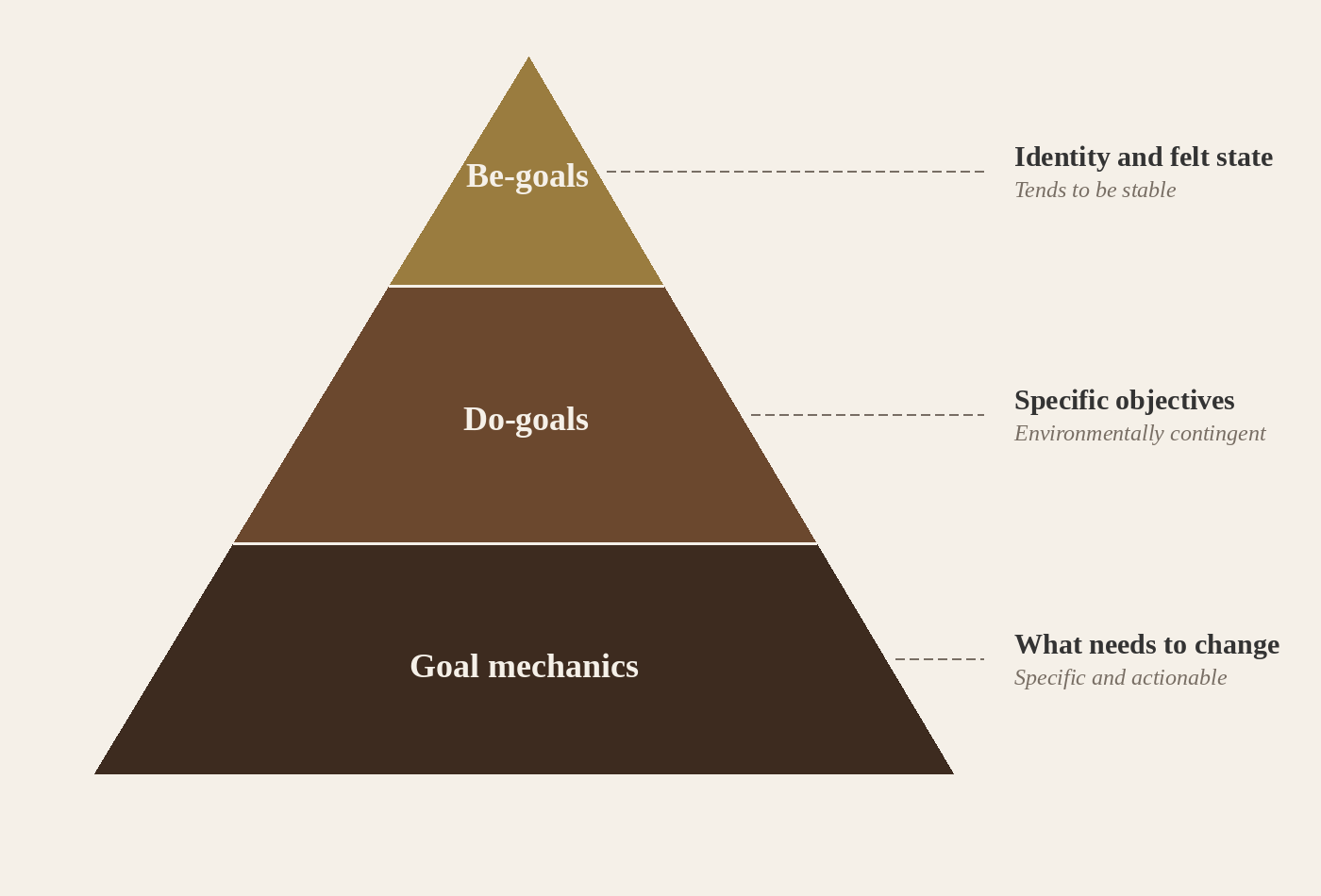
Be-goals sit at the top. These are goals connected to identity and felt state: the kind of life a client wants to be living, the kind of person they want to be within relationships that matter to them, what their situation feels like from the inside. These tend to be fairly stable across the lifespan and reflect our values and beliefs. A client whose be-goal is not to be a financial burden to their children will almost certainly hold that goal through job changes, market movements and significant shifts in their circumstances.
Do-goals sit in the middle. These are the specific objectives that express higher-order be-goals given current circumstances. A retirement age. A portfolio target. A financial commitment to children. These are plannable and concrete. They are also environmentally contingent, shaped by the situation in which they were formed. Unsurprisingly, they tend to dominate the discovery conversation, both because of how the conversation is designed and because most clients will default to socially acceptable, albeit incomplete accounts of what they truly want, and not all advisers will have the courage or skills to probe further.
Goal mechanics sit at the bottom. These are the specific behaviours, relationship dynamics and situations that a plan actually depends on. The spending pattern that needs to shift. The conversation with an adult child that needs to happen. The business arrangement that needs restructuring before the numbers can work.
Most discovery conversations operate at the do-goal level and work downward toward goal mechanics from there. The do-goal is identified; the goal mechanics are the steps required to reach it. This is a reasonable sequence. What it tends to omit is the be-goal above it.
Without that anchor, there's no stable referent when circumstances change, and neither adviser nor client has a higher-order commitment from which to recalibrate. It is also part of what makes client conversations difficult in volatile markets. Without a be-goal to point to, the conversation has nothing to hold onto except the numbers.
Approach vs Avoidance
Even when a discovery conversation reaches beyond surface goals, the questions tend to be approach-oriented[^Higgins, E. T. (1997). Beyond pleasure and pain. American Psychologist, 52(12), 1280–1300.]: what does the ideal future look like, what would achieving this open up, what would it give you? These work well for clients whose motivational system is oriented toward desired states, toward a positive end point they are building toward.
A significant proportion of clients, and perhaps the majority in contexts where financial planning matters most, are organised around the opposite direction. Their motivational system runs on avoiding feared states rather than approaching desired ones. The driver is the dread of running out, not the ambition to build. The worry of becoming a burden, not the desire to grow the estate. The anxiety of losing what exists, not the pursuit of something more.
These orientations are rarely chosen. They tend to have roots in personal history, family experience and cultural context that no discovery conversation is equipped to dissolve. Unfortunately, most discovery conversations compound this. They evolved, under the influence of coaching and positive psychology traditions that have genuinely improved practice, toward questions organised around aspiration, ideal futures and what makes life meaningful.
For approach-oriented clients this was a significant step forward from transactional fact-finding. For avoidance-oriented clients it imported a kind of mismatch that feels more engaged but reaches the wrong motivational system. Approach-framed questions tend to produce thin, obliging answers from clients in this orientation, not because they are disengaged or unmotivated, but because the question is aimed at the wrong system. The conversation makes no contact with what is actually driving them.
Both are addressable within the discovery conversation itself, without replacing what it already produces. Two additional moves, one that works on the goal structure and one that surfaces the motivational system, are sufficient. Neither requires a new protocol or a separate session.
Going beyond stated goals
Step 1: Goal structure
The first step is to map the goal structure. What emerges is a three-tier picture of each goal. One or two be-goals at the top. The do-goals from the discovery conversation in the middle. The goal mechanics at the bottom. The technique for building it uses two directions of questioning from any stated do-goal.
Ascending: ask 'what would having that give you?' rather than 'why do you want it?', which tends to invite rationalisation and activate defensive strategies. Repeat until the answer shifts from an objective to a felt state or an identity claim, typically in three or four iterations. The point at which the answer moves from objective to felt state is the be-goal. That is the stable anchor for the plan.
Descending: ask 'what would actually need to change for that to become possible?'. Frame the question around behaviour and circumstance rather than cashflow. The aim is to surface what needs to shift in how the client lives and works, not to identify financial targets. What does the client themselves need to do differently? What needs to shift between them and another person? What about their circumstances needs to change before the plan can work? The result is the set of goal mechanics the plan actually depends on.
Below is a starting point for the next discovery meeting. Select a few of the suggested questions that feel most natural, copy them across or print them to have in the room:
What the map produces is not a better goal list. It is a goal structure, with a stable top, a plannable middle and a specific bottom.
Step 2: Motivational system
The second step is to understand the motivational direction behind the goal structure. While some clients are primarily oriented toward desired states, others will be primarily motivated by avoiding feared ones. What you need is to ask two quesitons, introduced naturally in the flow of your discussion. One framed in terms of gains and one in terms of losses.
A few questions for both orientations are below. You only need one from each category. Select the ones that feel natural for the client in front of you and bring them into the next meeting.
The diagnostic is not the content of the answers. It is which question the client answers with more animation, specificity and unprompted detail. That tells you something about their motivaitonal system. Knowing this then becomes an important component of how you maintain relationship with the client. The plan does not change. How it is described, referred back to and communicated across the relationship does
Following these steps means that what the adviser holds now is something different from a goal list: a be-goal anchor that is stable across circumstantial change, a set of goal mechanics that define what the plan actually requires and a motivational register that determines how the plan needs to be communicated to remain live between meetings.


