
When a new report on the value of advice arrives, I do something most readers skip. I go straight to the methodology, printed in the same small font as the disclaimers, and for much the same reason. That is the psychologist's reflex, and not the one people expect. Couches and childhoods are the popular idea of psychology. The real training is a precise question, and a settled suspicion of the neat number that answers it, years of gruelling statistics saw to that.
Now another has landed, and deserves some scrutiny. Russell Investments, in its latest annual study, puts a financial adviser's value at 4.92%.1 The figure has form: it keeps rising. Morningstar's Gamma work first set it near 1.59% a year2; Vanguard's Advisor's Alpha then arrived at about 3%3.
Notice who is doing the counting: two asset managers and a data house, all of them in the business of putting numbers on things. So the value of advice arrives, naturally, as a figure. A magic number, of sorts, and one with a habit of spreading.
And yet it has not persuaded the people it describes. The Financial Conduct Authority puts UK advice take-up at 8.6%4. In the US the range runs somewhere between 9% and 27%. If the value were as self-evident as 4.92% makes it sound, you would expect more takers. And yet here we are.
The figure's flaws
None of this makes the studies wrong. The intent and the overarching message behind them is sound: financial advisers do add value, often more than they charge. What is shakier is the instrument, and it falls short for three separate reasons.
The first is methodological. Each estimate is built by comparing a client prone to costly mistakes against an adviser who reliably avoids them — a pairing that is, statistically speaking, improbable to the point of flattery. It is the kind of comparison that makes any intervention look decisive.
The second is mathematical. Defaulting to averages is the industry's reflex, and the value-of-advice figure is built from the same instinct. An average client, with an average set of problems, produces an average figure of value, true of everyone in general and no one in particular. 'Markets tend to recover' is my own favourite version of the same habit, comforting in the aggregate and deeply unhelpful to the one client living through the fall.
The third is psychological. Value calculated from outside the relationship is handed back as a single number meant to stand for every client at once. But nobody's actual experience of being advised looks like an average. It looks like whatever one person felt, in one relationship, over time.
Rather problematically, there is another cost, less discussed than the first three, and possibly the most consequential. A headline figure can work against the very advisers reaching for it. It is newer advisers who tend to lean on it hardest, the number placed front and centre in their marketing.
The figure is compelling. To the adviser. Clients, going by the take-up numbers above, are considerably less moved. A basis point answers a question nobody sitting across the table actually asked.
The more experienced advisers, the ones with a fuller pipeline, solid AUM and confidence in how their own exit will go, tend not to lead with the number at all. They know their value was never going to fit in a basis point, and stopped trying to make it. What they reach for instead is a habit borrowed from psychology: asking, not telling, and letting the client's answer outrank the average. Three questions do most of that work.
The three questions
Psychologists tend to open a conversation with an invitation rather than a claim: 'What's on your mind?' is a popular one, habitual even. Some of us call it the magic question.
Asking this question is a habit of my own, something I barely noticed until a colleague held up a mirror. During one of our 1:1s, I asked, almost on autopilot, 'what's on your mind?' He laughed. 'That's exactly the kind of question you'd expect from a psychologist,' he said. On reflection, I realised the question had become a reflex, alongside a few others, like placing my chair at the angle you'd notice in a therapist's office, if you were the sort of person who noticed such things.
The question is not new to this profession, even if it is still underused in it. Years ago, Rob Knapp, the father of the Supernova model5,6, brought Michael Bungay Stanier's coaching questions7 into financial advice, to help team leads become better coaches. Both books are well worth a cover-to-cover. The idea holds up as well now as it did then. 'What's on your mind?' has always belonged in a coaching conversation. It belongs equally in a value discovery one, alongside two others, asked sequentially:
- 'What's on your mind?'
- 'Where would you put things right now, on a scale of one to ten?'
- 'What would move it one point higher?'
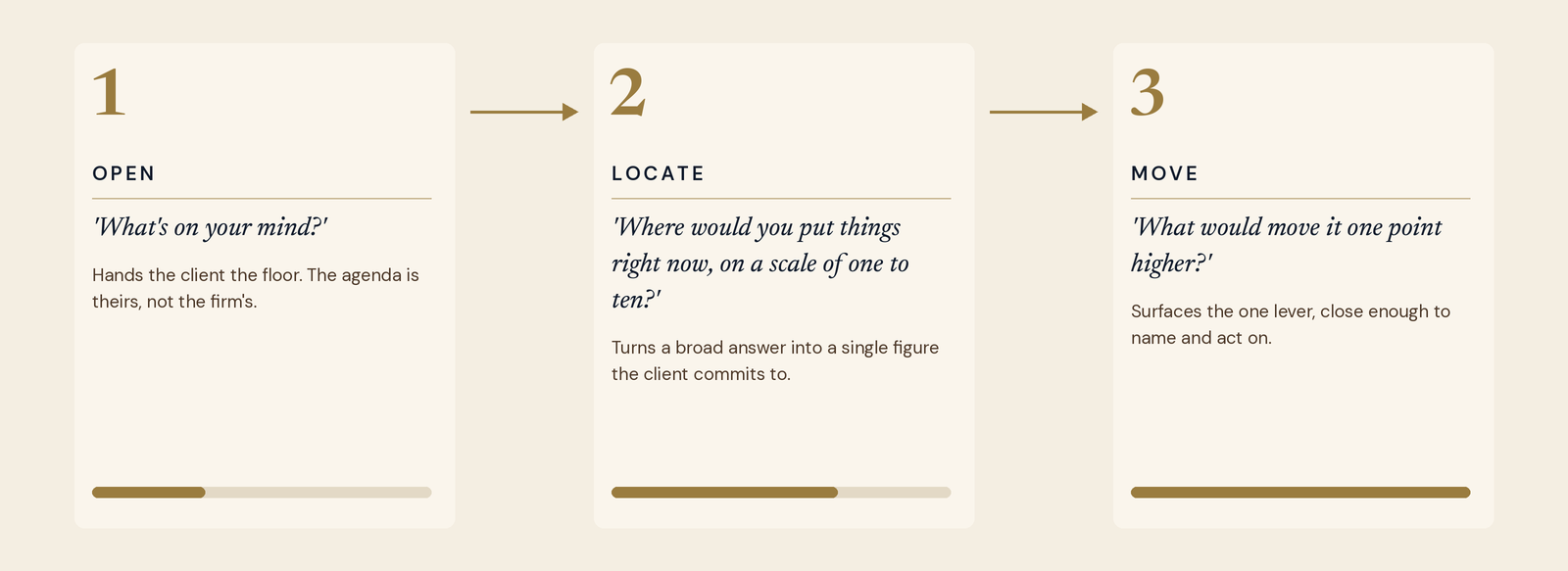
Each question is doing specific psychological work, and the order is not incidental.
Most value questions carry an implicit frame, and most clients have learned to answer it politely, vent through it, or ignore it outright, since it asks for their time without giving much back. 'What's on your mind?' doesn't fit the script, so it doesn't invite the same performance. What it invites instead is more, and often better: in investigative interviewing research, unbounded prompts reliably produce longer, more detailed answers and ones that are less contaminated by the interviewer's own assumptions, since nothing in the question has already told the client what to look for.8
An open answer is rich, but it is rarely precise, and precision is what the second question is for. 'Where would you put things right now, on a scale of one to ten?' takes whatever the client has just said and asks them to commit to a single figure. Underneath it sits a mix of things pulling in different directions, the sense of being looked after, a cost that feels less justified than it used to, a small friction easy enough to excuse and persistent enough to notice, and weighing each one separately costs more effort than the mind is willing to spend. So it substitutes an easier question, roughly, how do I feel about this, and answers that instead.9 What comes out is a gist, not an audit, and no less honest for it. It is also, usefully, incomplete.
Somewhere in that same mix sits the thing that would move the number, and the third question goes looking for it. 'What would move it one point higher?' deliberately doesn't ask what a ten would look like. A ten is too far away to answer honestly, and tends to produce either silence or flattery. One point is close enough to name, which is the entire design: solution-focused therapists have used this exact narrowing for decades, because a small, reachable target pulls more honest effort out of someone than a distant, perfect one ever does.10 It also plays to how people actually recall an experience, which is rarely an average of every moment and usually just the sharpest one.
This short, qualitative conversation does something neither the magic number nor the CSAT (customer satisfaction) or NPS (Net Promoter Score) can: it surfaces the value already received, the value still wanted, and the distance between them, in the client's own words. None of it requires a study, a methodology section or a disclaimer to cover the claim.
What it produces instead is something rarer: real value, for a real client, at a real practice. Not an average built from statistical acrobatics and a client who never existed. Something an adviser can actually put to work.
Putting it to work
Ask the three questions across enough client conversations, and a pattern starts to show. Certain kinds of value come up again and again, becoming a pattern that isn't a guess but a practice's own, genuine differentiator, built from what its own clients actually said. The same conversations also reveal where value is thin, which is less flattering and considerably more useful. A theme that never comes up is as informative as one that does.
None of this compresses easily into a single figure, and that is fine. There is a name for what happens when a number becomes the whole story: the McNamara fallacy. Measure what's easy, ignore the rest, and the rest starts to look like it was never there. The industry's magic number has been doing this for years.
The number may look tempting to drop into your marketing, or to mention casually in conversation. Resisting that urge is probably the sounder investment in your brand. After all, the value of advice was never going to live in a figure built to describe everyone in general and no one in particular. It lives in whatever this practice's own clients keep telling it, in their own words, whenever someone finally asks.


