
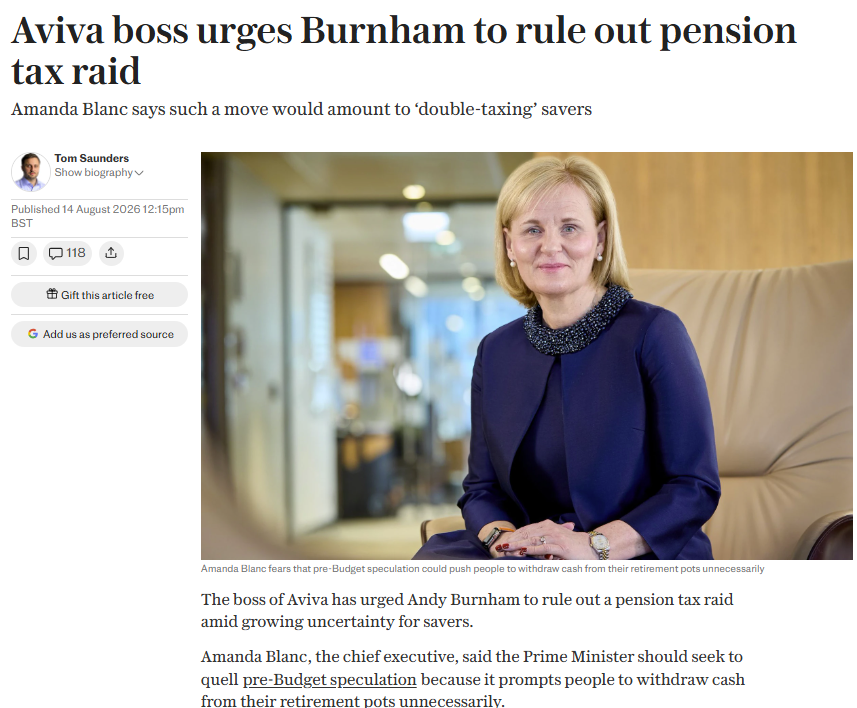
Buried in a recent Telegraph piece was a behavioural observation that deserves more attention than it received. Amanda Blanc, the chief executive of Aviva urged the government to rule out a pensions tax raid, not only because of the policy itself, but because of the speculation around it. Her point was that rumour alone prompts savers to withdraw cash and make decisions they later regret.
That is a psychological claim as much as a fiscal one, and it turns out to be more than intuition.
Trust is a promise of certainty
Trust is the foundation of any functioning, prosperous system, society being one of them. At its core, it's a promise of certainty, whatever form it takes, and is deeply rooted in us. For our ancestors, certainty meant a higher chance of survival, and survival was at a premium on the vast and hostile plains of the ancient savanna where the human mind was shaped.
Our brains have changed remarkably little since then, so the need for predictability is still with us. Anything that erodes it tends to cause lasting damage, not only to the individual but, in aggregate, to the collective wellbeing and prosperity of a nation.
Saving for retirement is, fundamentally, an act of trust. We give something up now on the promise that when the time comes we will have the means to survive and thrive. It is a bargain made across decades, with a counterparty (the state, the system, our future selves) that we cannot fully see.
Which is precisely why the nature of pension changes matters so much. When a change is additive, it strengthens the bargain. When it is deductive, it quietly rewrites it. Each time the rules are tinkered with in a way that takes something away, the mind forms a schema: nothing here is sacred, nothing is guaranteed, and anything can be removed at any time. Follow that logic to its conclusion and saving for retirement starts to feel like a fool's errand.
This lands on top of a difficulty that already exists. Planning for the long term is genuinely hard for us, for much the same evolutionary reasons. We are wired to weight the immediate over the distant, which is why present bias defeats so many good intentions.
So clients carry a double burden. There is the internal obstacle, a mind poorly built for forty-year time horizons, and now the external one, a policy environment that periodically seeds panic and speculation. One makes retirement saving hard. The other can make it feel pointless. Together they are corrosive.
The evidence is remarkably consistent
Long before the current Budget speculation, a UK-based study by Taylor-Gooby (2005) found that pensions were already a low-trust affair, and that the deepest scepticism sat with the educated and economically productive middle class.1 Their distrust of pensions was really a distrust of losing control, and it travelled straight to the government of the day, which they rated poorly. None of this is new. When ministers tinker, they are pulling on a thread that was already frayed.
Another study, this time from Singapore, shows what that scepticism costs: Singaporeans who distrusted government officials were far more likely to cash out their pension at 55, forfeiting a safe return of 2.5 to 4 per cent, while those who trusted them held around 10 per cent more.2
The most telling part is almost an accident of timing. In January 2019 a false rumour spread on social media claiming the government had quietly raised the CPF payout age. It was untrue, and the authorities corrected it.3 Yet when the researchers compared trust before and after, they found a statistically significant fall in trust in CPF officials in the wake of the rumour alone. Nothing had actually changed. Speculation by itself moved the needle. That is, in miniature, exactly the mechanism the Aviva chief executive was warning about.
And here is why the reassurance that a raid "only touches a wealthy few" does not hold. Trust travels. Yang and colleagues (2024) show that trust in institutions matters most for people with the lowest financial literacy, because trust is what they use in place of expertise.4 These are, disproportionately, the people who will lean hardest on the state in old age. Erode their confidence and you do not merely inconvenience the rich; you quietly undermine the planning of those least able to recover, and most likely to fall back on the taxpayer.
Twenty years of tinkering
In the two decades since Taylor-Gooby wrote, clients have been handed a steady stream of interventions that, viewed through a behavioural lens, range from genuinely good to plainly counterproductive.
On the good side sit auto-enrolment, which harnessed our inertia instead of fighting it; the pension freedoms, which handed people back a measure of control; and the abolition of the lifetime allowance, which stopped penalising those who saved diligently. On the other sit the tapered annual allowance and, now, the pulling of unused pensions into inheritance tax.5
The distinction has nothing to do with political affiliation and everything to do with psychology. Making saving easier, widening autonomy and setting no ceiling on how much a person may provide for their own future all run with the grain of a well-established finding: autonomy is a basic human need, not a luxury.
Telling someone instead that providing for their children, often at the expense of their own comfort in later life, will now be taxed, or that ambition itself should be capped, cuts against that grain. In behavioural terms it is an own goal, because it dampens the very motivation a state needs its citizens to feel.
What this means for financial planners
For financial planners, all of this points in one direction. Moments like this are where psychological preparedness and behavioural coaching stop being a phrase and starts doing real work. This is when a good planner becomes more than an adviser. They become a trust anchor, the steady point a client can hold onto while the institutions around them keep giving reasons not to. Three things seem to matter most.
- Get ahead of the panic conversation. Speculation peaks in the run-up to fiscal events, so reach clients before it does. Proactive outreach does two things, both about service. It signals care: the client feels held in mind, not left to chase you. And it spares your practice, because waiting for the anxiety to build invites the avalanche, the week of panicked calls that turns a planning business into an emergency room. Reach out first and you stay in a considered conversation instead of a reactive one. Rob Knapp's Supernova model captures this beautifully, a recurring twenty-minute monthly call with every client, turning "getting ahead of it" from good intention into fixed routine.6 Regular contact by design, so the relationship never has to be rebuilt in a crisis.
- Keep politics out of it. Policy conversations are, by their nature, political, and it is entirely fine to hold political views, even strong ones. In 10 Mistakes Financial Advisers Make, Howard Lashner puts it sharply: it is wise never to bring them to clients, even when you seem to agree.7 The reason is partly commercial: the client who shares your view today has a brother who does not, and there goes a referral. When a conversation drifts towards politics, the more useful move is to steer it back to the economics, to how a given change actually bears on their investments and their plan. That is where the real value lies: helping clients earn what Paul Armson and Mitch Anthony call the best possible return on their life (ROL)8, and offering the behavioural coaching that keeps fear from hardening into an irreversible decision.
- Work with the control instinct, not against it. Policy change reminds us, somewhere beneath the surface, that most of us are cogs in a vast machine, that there is always someone, somewhere, with the power to do something we can do little about. Even in a democracy. It brushes against our occasional powerlessness, and that is precisely why it unsettles. So this is the moment to turn clients back towards what they can control: their goals, and the plan built to reach them. The value of investing early, of staying the course, of holding on for the long term. We cannot control the markets, or the Budget. But we can control how we behave whatever they do, and that, in the end, is what shapes the outcome.
A commodity in short supply
I should admit a personal sensitivity here. Having grown up in a state where institutions could not be trusted to keep their promises, I notice the erosion of trust more keenly than most. It sharpens the attention. And it is why I keep returning to one thought: trust is a commodity in very short supply, and getting shorter.
We are wired for certainty and living through an era determined to withhold it. A planner cannot promise the rules will hold, and should not pretend to. What they can do is be the steady counterweight to the churn, the person who keeps a client's forty-year plan intact while the headlines insist it is not worth having. In the end, that is what financial planning has always been: not the management of money, but the management of trust.


